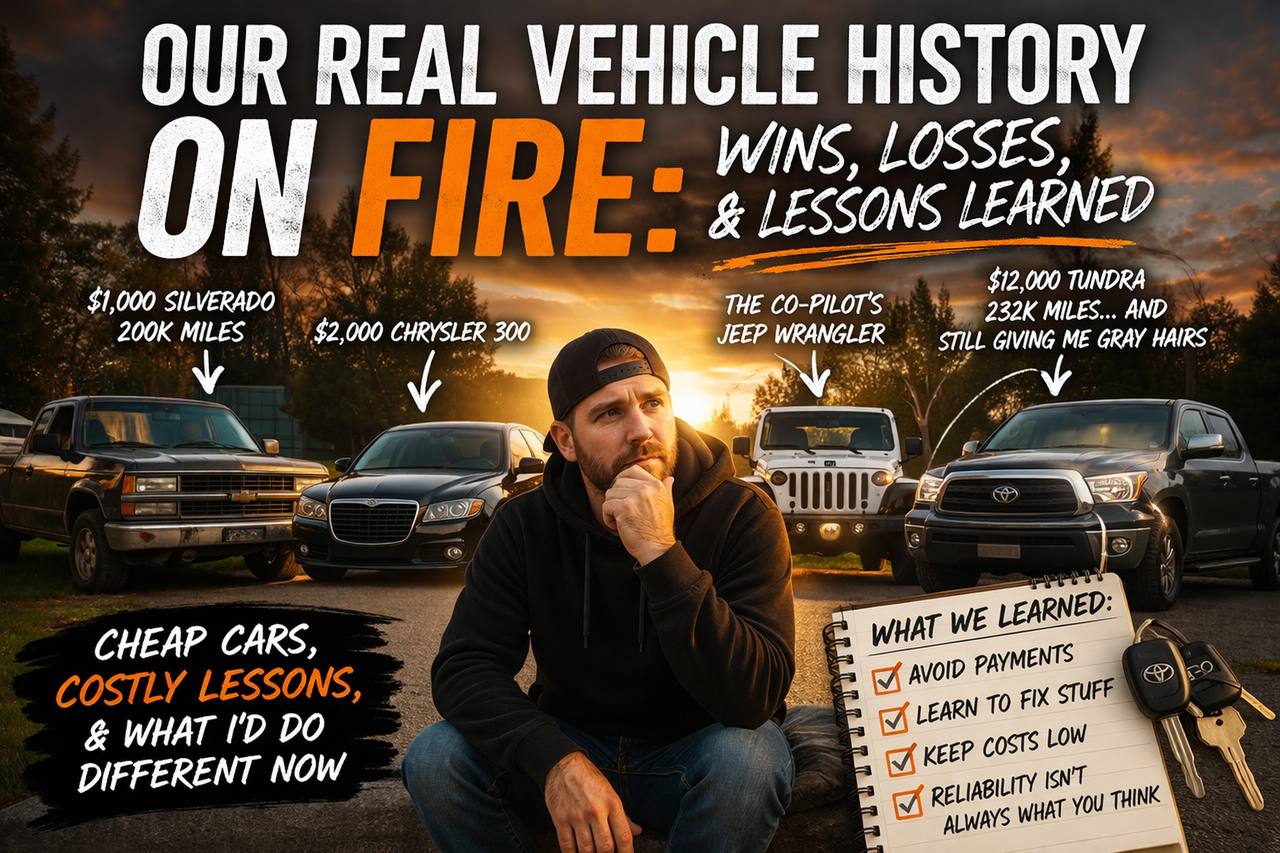
When people talk about financial independence, they usually talk about investing, income, or cutting monthly expenses.
That makes sense. Those things matter.
But vehicles can quietly wreck a family’s finances too. The purchase price is only the start. Insurance, repairs, maintenance, and the urge to keep upgrading all add up fast.
Looking back, our vehicle decisions have shaped our FIRE journey more than I expected.
We did not follow some perfect plan. We bought what we could afford, fixed what we could figure out, and made decisions in real time. Some of those choices saved us a lot of money. Others taught us lessons the hard way.
This is not advice. It is just our story.
How we think about vehicles and financial independence
Want more real-talk FIRE strategies for families?
Get the Family FIRE Letter — monthly real numbers from our family to yours.
I did not start with some polished strategy.
I mostly just wanted to avoid payments, keep costs low, and make things last as long as possible. Over time, I started learning how to fix things myself, mostly from YouTube, and that probably saved us thousands.
What I have learned is that the vehicle itself matters less than the way you own it.
Some of the cheapest vehicles we have had turned out to be the best financial decisions. One of the more expensive ones has easily been the most frustrating.
My first truck: the $1,000 Silverado
My first vehicle was a 2001 Chevy Silverado with 200,000 miles on it. It was rough. The rocker panels and running boards were rusted out, but it ran and had a good set of tires.
I paid $1,000 cash for it.
That was the whole strategy.
I did not care what it looked like. I needed something that worked, and I did not want a payment hanging over me.
Over time, I started learning how to take care of it myself. I cut out rust, cleaned it up with primer and rust converter, and used Duplicolor to make it look a little more respectable. I even added hard plastic fender flares just to help it look halfway decent.
Mechanically, I kept it alive the best I could. I replaced brake lines, did the brakes, rotors, and calipers, and stayed on top of oil changes. Everything I learned came from YouTube.
I kept costs low everywhere I could, including carrying liability insurance only. I was not trying to protect the truck. I was trying to keep it on the road without spending more than I had to.
I drove that truck for about five years. Eventually, the head gasket started going. I knew the repair would cost more than the truck was worth, so I sold it at auction for $1,400 and moved on.
That truck ended up being one of the best financial decisions I have made. Not because I made money on it, but because it taught me that good enough can go a long way when your goal is financial progress.
The Co-Pilot’s Jeep: buy once, keep it
The Co-Pilot took a completely different route.
In 2019, she bought a 2016 Jeep Wrangler for a little over $20,000. She had just gotten her first real job out of college, and this was something she had wanted for a long time.
This was not about finding the cheapest option. It was about buying something she really wanted and planning to keep it for a long time.
That is exactly what happened.
The Jeep has been paid off, dependable, and low stress. It just hit 61,000 miles this year. Outside of basic maintenance like oil changes, brakes, and rotors, it has not needed much. It fits our family of four well, and we have no plans to sell it anytime soon.
This one is not a win because it was cheap.
It is a win because it was intentional.
She made one decision, stuck with it, and avoided the cycle of upgrading every few years. That kind of discipline matters just as much as buying cheap.
The $2,000 Chrysler: simple and low risk
After I sold the Silverado, I picked up a 2005 Chrysler 300 for $2,000.
It was nothing special, which was kind of the point.
I handled the basics myself. Oil change, brakes, rotors, and eventually a half axle after a wheel speed sensor went out. Like before, YouTube filled in the gaps.
I drove that car for about two years and sold it for $1,500.
It was simple. It was low stress. It did exactly what I needed it to do.
Looking back, that was another solid move. Not exciting, not flashy, just useful.
The Tundra: the upgrade that did not feel like one
After the Chrysler, I decided to upgrade.
I bought a 2007 Toyota Tundra for $12,000 with 209,000 miles on it. It now has about 232,000 miles, and I still own it.
At the time, I thought I was making the smarter long-term move. Toyota has a strong reputation for reliability, and I wanted something I could drive for years without constantly worrying about it.
Some of that has been true. The truck still runs strong. The transmission shifts well. I added a $300 touchscreen radio with CarPlay, and honestly that made it feel a lot newer than it is.
But this has also been the most frustrating vehicle I have owned.
At first, it felt manageable. I replaced the starter, did the brakes and rotors, changed the oil, and swapped the transmission fluid. Normal stuff.
Then the problems started stacking up.
About six months after I bought it, the heat stopped working on the driver side. The passenger side works. The rear cab works. Just not the driver side.
I have taken the dash apart three different times trying to fix the blend door actuators. I can manually get it working, but once I put everything back together and change a setting, it falls out of place again.
So I have been driving through winters with no heat on my side, in negative 20 degree weather.
Then the rear window stopped working.
Then I backed into a concrete pillar in a parking garage after squeezing into a spot meant for compact cars.
Then a deer ran straight into the driver side door and fender.
Now I am looking at around $9,000 in potential repairs.
That is the part that messes with me.
Part of me wants to file a claim, total it out, pay off what is left, and move on.
The other part of me looks at everything I have already put into it and thinks, I have made it this far. I have dealt with the no-heat winter problem. I have almost got it paid off. Why start over now?
I thought I was upgrading when I bought this truck.
It has not felt like an upgrade.
What these vehicles taught us
Looking back, a few lessons stand out.
The cheapest vehicles gave us the most flexibility.
Learning how to fix things ourselves saved us more than I realized at the time.
Avoiding constant payments mattered more than driving something impressive.
And maybe the biggest lesson is this: a more expensive vehicle does not automatically make your life easier. Sometimes it just gives you a different set of problems.
Where we are now
Right now, we still have both vehicles.
The Jeep has been steady, dependable, and exactly what it was supposed to be.
The Tundra has been the opposite. It still runs, but it has tested my patience more than any vehicle I have owned.
We are still figuring out what the right move is from here.
The bigger question
This is the question I keep coming back to:
What actually costs more over time?
A vehicle with a predictable payment, or one that keeps surprising you?
Vehicle summary
| Vehicle | Purchase price | Years owned | Outcome | Win or loss |
|---|---|---|---|---|
| 2001 Chevy Silverado | $1,000 | 5 years | Sold for $1,400 | Win |
| 2016 Jeep Wrangler | ~$20,000 | Ongoing | Paid off, low mileage, dependable | Win |
| 2005 Chrysler 300 | $2,000 | 2 years | Sold for $1,500 | Win |
| 2007 Toyota Tundra | $12,000 | Ongoing | High repairs, still undecided | TBD |
Frequently asked questions
Are cheap used cars better for FIRE?
Not always. What helped us most was buying vehicles we could afford, keeping them for a while, and learning how to handle repairs without rushing into another payment.
Is a reliable vehicle worth paying more for?
Sometimes, yes. The Jeep has been worth it because it has been dependable and we kept it. The Tundra is the reminder that paying more does not guarantee peace of mind.
What matters most with vehicles on a FIRE journey?
Intentional ownership matters most. Purchase price, repair risk, insurance, and how long you keep the vehicle all affect the real cost.
Frequently Asked Questions
Not always. What helped us most was buying vehicles we could afford, keeping them for a while, and learning how to handle repairs without rushing into another payment.
Sometimes, yes. The Jeep has been worth it because it has been dependable and we kept it long-term. The Tundra is the reminder that paying more does not guarantee peace of mind.
Intentional ownership matters most. Purchase price, repair risk, insurance, and how long you keep the vehicle all affect the real cost of owning it.
Start Building Your FIRE Foundation Today
Every dollar saved is a step closer to financial independence. Get the strategies that worked for our family sent straight to your inbox.
Books That Shaped Our FIRE Journey
These are the books we read and actually used. No fluff, no get-rich-quick schemes – just honest frameworks that work.
- The Simple Path to Wealth by JL Collins – View on Amazon
- Your Money or Your Life by Vicki Robin – View on Amazon
- Die With Zero by Bill Perkins – View on Amazon
* Affiliate links: we earn a small commission at no extra cost to you, thanks for supporting Rolling With Fire.
Vehicles are part of the bigger housing and lifestyle math equation.
Where you live affects how far your vehicle and housing costs actually go.
Want more real-talk FIRE strategies for families? See what we are building right now on the On Fire page.
emergency fund that handles real repairs
Are We Crazy for Giving Up a Comfortable Life
Want more real-talk FIRE strategies for families?
Get the Family FIRE Letter — monthly real numbers from our family to yours.