Housing is the budget item that can wreck your entire FIRE timeline, and most advice about fixing it is either useless or out of reach for a normal family.
Move to a cheaper city? Sure, if your job is fully remote and your kids don’t have roots anywhere. House hack with a rental unit? Great idea, unless you have a newborn and a toddler and managing a tenant sounds exhausting. Downsize? We’re already in a modest house. There’s not a lot of down left to size into.
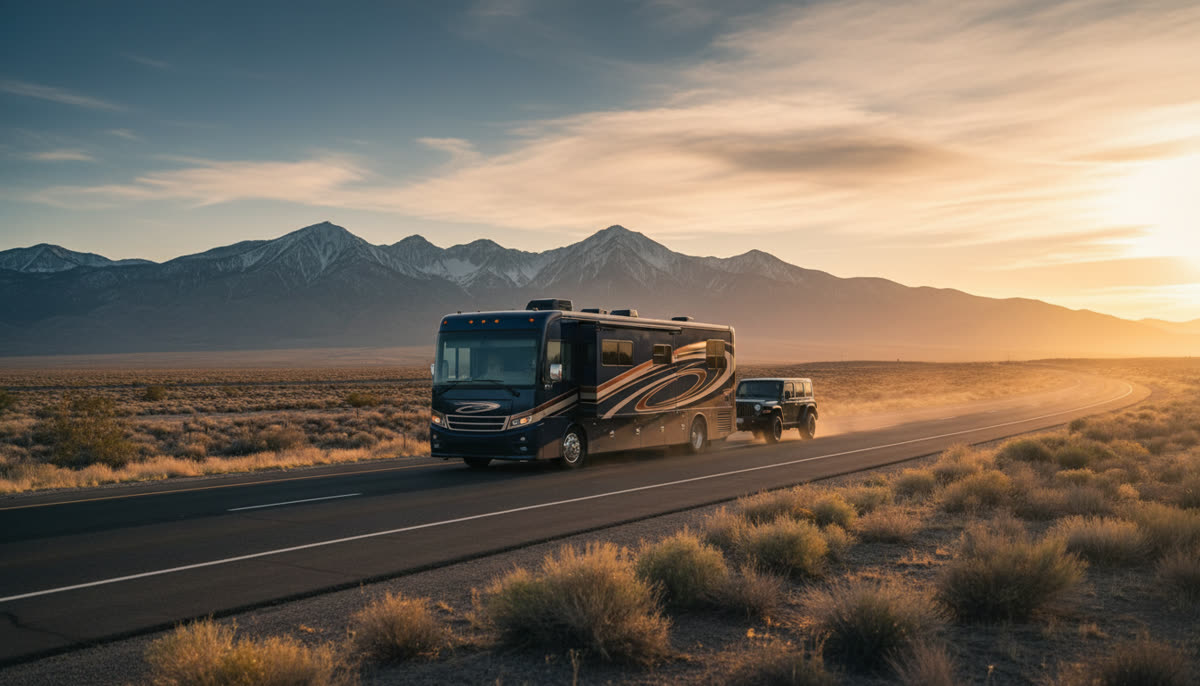
So we landed on an idea that, six months ago, I would have dismissed as a fantasy: a Class A motorhome as a primary residence. Not a vacation. Not a summer trip. An actual motorhome as the place where the Pilot family lives.
Here’s why the math keeps winning the argument.
The numbers that changed my mind
Want more real-talk FIRE strategies for families?
Get the Family FIRE Letter — monthly real numbers from our family to yours.
Houses in the area where I work start at $300,000 and go up from there. At today’s 30-year fixed rate of 6.37%, a $300,000 home with 10% down means a monthly payment around $1,685 before taxes and insurance. Add those in and you’re well over $2,000 a month. And that $300,000 price point doesn’t get you what you actually want. The houses that fit what we’re looking for aren’t showing up at that number right now.
Our mortgage, property taxes, and home insurance already add up to a number that makes my left eye twitch every month. We’re paying a premium to stay in one place. That’s the deal with homeownership. You trade flexibility for stability and hope the equity trade works out.
FIRE math depends on keeping fixed costs low so your savings rate can do the heavy lifting. When housing is eating 25-30% of gross income, everything else fights for whatever’s left.
Compare that to a paid-off Class A. Once it’s yours, the biggest monthly housing costs collapse. Campsite fees at full-hookup RV parks average $700 to $1,200 a month depending on where you park. Annual memberships with Harvest Hosts, Thousand Trails, or Passport America can drop that further. Some months you’re at a state park for $25 a night.
We’re not there yet. We still have a mortgage. But I’ve been running the numbers long enough to know that the gap between where we are and where we want to be might close faster with wheels under the house than with a third job.
What geoarbitrage actually means for a family with kids
Geoarbitrage gets floated as a FIRE strategy a lot, but it usually means “move to Portugal” or “work remote from Thailand.” That’s not realistic for us. I work in manufacturing. My Co-Pilot works in nursing. We can’t export ourselves to a lower-cost country and call it a win.
Domestic geoarbitrage is a different story. Groceries in rural Mississippi don’t cost the same as suburban Chicago. Property taxes in Wyoming aren’t what they are in Illinois. An RV doesn’t lock you to any of that. You pick your domicile state carefully, put your mail service there, drive somewhere warmer in January and cooler in July. You spend your time in places where your dollar stretches instead of being anchored to wherever you happened to buy a house.
One thing that doesn’t get said enough in the full-time RV conversation: we don’t schedule vacations anymore. We just drive to them. When we want to spend a week in the mountains, we go. When we want to explore somewhere new, we point the rig and go see what life looks like there. That shift in how you experience the country is hard to put a dollar amount on, but it’s a big part of why this keeps coming up in our Sunday night budget conversations.
The commute problem nobody solves for you
One thing I’m particular about: I don’t want to commute. A long daily commute is one of the bigger time taxes in a working person’s life and I’ve never made peace with it. My rule is 10 minutes from work, whatever that job is. That’s the radius I want to live in.
In an RV, that’s actually solvable in a way a traditional house isn’t. When I change careers or take a different role, we move the home. We park close to where I need to be. No 45-minute drive each way eating an hour and a half out of every workday, no sitting in traffic wondering why you’re spending 400 hours a year commuting when you could be home with your kids.
That flexibility is worth something real, even if it doesn’t show up on a spreadsheet.
The vehicle math nobody talks about
Right now we have two vehicles. Two insurance policies, both with full coverage, both with the ongoing maintenance and cost that comes with owning cars in the modern world.
In an RV setup, we go down to one. Our Jeep Wrangler is paid off and we’re keeping it. It gets flat-towed behind the Class A, which means we pull up somewhere, unhitch the Jeep, and use it for errands, exploring, and everything else we’d use a car for. No second vehicle payment. No second full-coverage policy. Just one paid-off Jeep and the campsite we parked at.
That’s a line item most people don’t factor in when they run the housing comparison. We did.
The real tradeoffs
Lil Spark is a toddler. Baby Spark is a newborn. Two kids in a motorhome is a different kind of life than a house with a backyard and separate bedrooms. Schooling on the road is a question we haven’t fully worked out. Medical appointments require more planning without a home base.
There’s also the cost of the rig. We’re looking at a used Thor Outlaw toy hauler, $75,000 to $110,000 for a reliable 2018-2023 model. Finance that and your monthly payment rivals your mortgage. The math only works without debt on the vehicle. That means this is a three-to-five year plan, not an impulsive pivot. Pay down the mortgage, save specifically for the rig, sell the house when the numbers line up.
You can read our full RV cost breakdown here if you want to see what full-time life actually costs versus what the Instagram version looks like.
Why we keep coming back to it
We didn’t get into this to optimize a spreadsheet and die having never left the Midwest. We want to show Lil Spark and Baby Spark that there’s more to the country than the neighborhood they grew up in. We want to sit at a campfire somewhere we’ve never been and feel like we chose that life on purpose, not stumbled into it during a two-week vacation we had to clear with HR three months in advance.
We’re still in accumulation mode, still figuring out the mortgage. But every month the campsite math looks better compared to our property tax bill.
What to do if you’re considering this
Run your actual numbers. Look at what housing costs today including taxes, insurance, and maintenance. Then look at what a paid-for RV plus campsite fees would actually run. Factor in the second vehicle you won’t need anymore. The gap might surprise you.
Talk to people who’ve done it with kids. Don’t wait until everything is perfect. The plan starts now. That’s the whole point.
If you want to see how the housing math fits into the bigger picture, the two-phase FIRE strategy post breaks down exactly how we’re thinking about accumulation and the finish line.
The Pilot, Co-Pilot, Lil Spark, and Baby Spark
Get the Family FIRE Calculator
A free spreadsheet showing your real timeline to financial independence based on your actual savings rate.
Frequently asked questions
Is living in an RV full time cheaper than owning a house?
For many families it can be, especially once the RV is paid off. Campsite fees typically run $700 to $1,200 a month, compared to mortgage, taxes, and insurance on a $300,000 home at today’s 6.37% rate. The savings grow further when you eliminate a second vehicle.
What is the best RV for a family with young kids?
Class A motorhomes with a toy hauler layout give families the most livable space and the ability to flat-tow a vehicle. We are targeting a used Thor Outlaw RV toy hauler in the 2018 to 2023 range at $75,000 to $110,000.
What is domestic geoarbitrage for FIRE families?
Domestic geoarbitrage means choosing where you live based on cost of living rather than where you happened to buy a house. Full-time RVers can park in lower-cost areas and domicile in favorable states like South Dakota or Texas to reduce taxes and expenses.
How does flat towing work with a Class A motorhome?
Flat towing means pulling a vehicle on all four wheels behind the motorhome with no trailer needed. A Jeep Wrangler is one of the most popular flat-tow vehicles because it handles towing well and is capable once you arrive at your destination.
Related reading
p>
Start Building Your FIRE Foundation Today
Every dollar saved is a step closer to financial independence. Get the strategies that worked for our family sent straight to your inbox.
Books That Shaped Our FIRE Journey
These are the books we read and actually used. No fluff, no get-rich-quick schemes – just honest frameworks that work.
- The Simple Path to Wealth by JL Collins – View on Amazon
- Your Money or Your Life by Vicki Robin – View on Amazon
- Die With Zero by Bill Perkins – View on Amazon
* Affiliate links: we earn a small commission at no extra cost to you, thanks for supporting Rolling With Fire.
Want more real-talk FIRE strategies for families? See what we are building right now on the On Fire page.
Frequently Asked Questions
Is an RV a realistic primary home for a family?
It is more realistic than most people assume, and less glamorous than the Instagram version. Families who make it work plan for the trade-offs: less space, maintenance demands, and community logistics.
What does an RV actually cost per month compared to a house?
It depends on whether you own outright or finance, where you camp, and how often you move. Some families report $1,500 to $3,000 per month all-in versus $2,500 to $4,000+ for a modest mortgage.
Does living in an RV affect FIRE timeline?
It can accelerate it significantly if housing costs drop enough. If you are paying $2,500/month in housing and you can live in an RV for $1,500/month all-in, the $1,000/month difference invested over 10 years is meaningful.
Want more real-talk FIRE strategies for families?
Get the Family FIRE Letter — monthly real numbers from our family to yours.